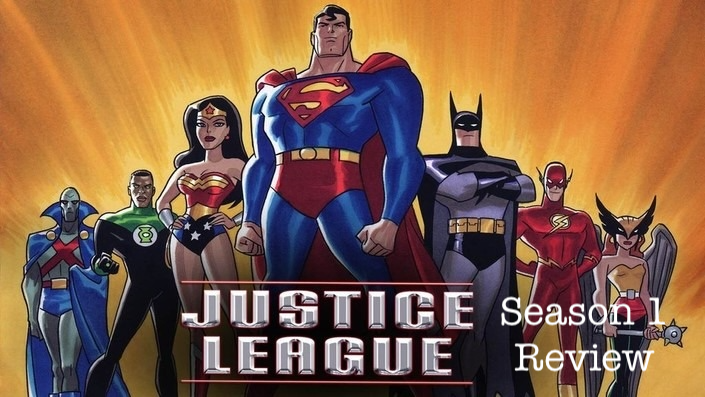
With Justice League‘s first 26 episodes in the bag, it’s time for a quick check in how the show is shaping up. You know, doing a terrible ranking of the creative team and all that other junk.

For background on the creation of Justice League and info about how I’ll be covering it, check out the Series Primer.
More Season Reviews:
Batman: The Animated Series (Season One | Season Two | The New Batman Adventures)
Batman Beyond (Season One | Season Two | Season Three)
Superman: The Animated Series (Season One | Season Two | Season Three)
No animation rankings this time because Koko did literally every episode. That’ll change next season.
For the purposes of tallying writer/director/composer totals, I treated each combined story as one episode rather than splitting them into their individual parts.
Season Review
I would say the biggest success of this debut season was how deftly they took advantage of effectively doubling (or even tripling) the runtime of their stories, and all the things that afforded.
Trying to give proper time to SEVEN main characters is a difficult thing to do… which is why most episodes sidelined at least one member of the team. That may sound like a criticism, but I think it’s more of a necessity given what they were trying to achieve here. Bruce Timm acknowledged the challenges of trying to juggle multiple heroes, any guest characters for a given episode, and the general premise and villains, as there are only so many minutes to go around. Making every episode a two (or three) parter was the solution to this, taking advantage of Cartoon Network letting them do basically whatever they wanted. It’s kind of amazing watching this season knowing they’ll eventually move on to a single-episode format with JLU, but we’ll cross that bridge when we come to it.
In BTAS especially, I tended to criticise multi-parters because the first half would be heavy on story and character at the expense of feeling unfinished, while the conclusion would toss most of that out the window in favour of wall-to-wall action, which can feel hollow. They definitely got better at this over time, with STAS having some of the best balanced two-parters up to that point, but it almost never feels this way in Justice League. Instead most of the time it feels like a 40-minute episode split in half, give or take a few fun cliffhangers. It’s more about the extra minutes they get to play with and how they use those for small touches and interpersonal relationships, which tend to be the first things to get cut for time. Multiple episodes of this season feature a sequence where the team are rescuing people instead of just fighting bad guys all the time. More of this in superhero media, please! And the whole reason you do a team-up show is so you can play with the differing points of view of the various members, whether there’s romantic tension, firm friendship, or even butting heads. The stern Batman and Green Lantern often snap at Flash… along with most women he meets. Martian Manhunter’s quiet introspection makes the more thoughtful Superman and Wonder Woman natural conversation partners. Hawkgirl’s passionate nature means she can be yelling at one of her teammates one moment, and engaging in flirty banter the next. All of this is perhaps best exhibited by the burgeoning romance between John and Shayera, which of course started out with mutual disdain, before a few moments of vulnerability endeared them to one another (again, only afforded by the extra run time!) and by the end they’re cracking wise and flirting.
My other main takeaway from this first season was the smart decision to use this big team of powerful heroes as an excuse to go bigger with the world of DC. I really dug how the early episodes took us to the far reaches of space and then the depths of the ocean. How we got to spend time with the Atlantean and Amazon cultures. By the end of this season the team had crossed into an alternate reality, gone back in time, and even had a stab at sword & sorcery. This is great. More of this please. Conversely I found myself disappointed whenever they opted to ignore these kinds of opportunities, such as the refusal to engage with the struggles of the common folk of War World, or almost completely refusing to shine a light on Gorilla City.
On the more negative end of the scale, while I think some of the ‘Superman is so weak!’ criticism is overblown, it is tough to ignore that they were clearly trying very hard to bring the newcomers to the forefront and put him and Batman in the backseat a little. In some ways this worked, as Green Lantern’s powers always look cool, Hawkgirl’s aerial combat was fun, and Martian Manhunter’s array of abilities were absolutely bananas. But Flash was really all over the place, and it’s him that bothers me far more than Superman. For one thing they could never decide how fast he’s really meant to be, with him failing to catch up to a truck in one episode, while being fast enough to sprint across the Atlantic Ocean in another. It irks me that his reaction times seem to be so slow, and he’s often easily taken out by characters just guessing where he’s going to be. Some of that is just the nature of the beast, as Flash on paper is one of the most powerful characters in comics, and you have to nerf him a bit to tell compelling stories, but hey. Wonder Woman was also a bit of a mixed bag, as they’d have her demonstrate her incredible power every so often, and then shrink into the background a bit. I guess they did portray her stronger as the season went on. What I’m saying is they had their clear favourites, and it would be nice to see everybody get more of a chance to shine next season. When they were working together in big battle scenes worthy of the epic feel they wanted for the team, it was stellar, most notably in ‘Injustice for All‘ and ‘The Savage Time.’
It is unfortunate that the DCAU has shifted little by little away from what helped it establish such a strong legacy in the first place. Justice League is not defined by exceptionally strong voice acting – though the cast’s chemistry is a definite boon. No ‘Best Performances’ section this time around. Nor are the villains overly compelling, frequently losing the battle for screen time to keep the focus on the group dynamics of our titular heroes. The almost anachronistic art design of Gotham and Metropolis is gone (as well as Beyond‘s whole-cloth futuristic aesthetic), and instead every location here looks normal and modern (read: dull). The gorgeous painted cells are out, and instead there’s this weird hybrid digital art that makes lighting and certain animation touches smoother, but at the expense of there being an uncanny feeling half the time where the characters look like they’re not in same world as the backgrounds. The music has remained solid, but stood out just that little bit less. BTAS style Title Cards have been gone for a long time (seemingly dropped as one of their conditions for making TNBA, along with ditching some other stylistic flourishes), and nothing remotely like them has cropped up since. I can only speculate as to why all of this is the case, making wildly unfounded accusations about power struggles in the creative team and how things overtly shifted toward Bruce Timm and his inner circle versus the Alan Burnett/Paul Dini alliance. All I know for certain that it’s all a shame. This is a very clean show, with barely an animation flub to be found, and much naturalistic movement and all that jazz. Did I mention the improved lighting? It just feels like it lost a little soul in the process.
But hey! Even a slightly worse DCAU is still better than basically all superheroes cartoons in history.
Director Rankings
- Butch Lukic (7 eps)
- Dan Riba (7 eps)
Full disclosure: they actually tied. Deeply disappointing when it was already boring to only have two directors split all the work between them. Variety is the spice of life and all that.
I chose to place Butch Lukic in the top spot because of the three-parters that opened and closed the season. Dan Riba did two of the three episodes that make up ‘Secret Origins‘, while Lukic handled two-thirds of ‘The Savage Time’, and I HUGELY preferred Lukic’s ending to Riba’s beginning.
If you took those shared episodes out of the equation it would be almost impossible to get a piece of paper between the two. They swap back and forth in positions 2-6, then Lukic has three in a row, and then Riba has the bottom two. I guess you could call that a very soft Lukic edge?
Both of these guys proved themselves as DCAU work horses during TNBA and STAS, but I would struggle to identify a trademark style for either man… but that’s exactly what Bruce Timm likes!
Writer Rankings
- Andrew Kreisberg (1 ep)
- Joseph Kuhr (1 ep)
- Stan Berkowitz (5 eps)
- Kevin Hopps (1 ep)
- Keith Damron (1 ep)
- Rich Fogel (2 eps)
- Dwayne McDuffie (3 eps)
- Len Uhley (1 ep)
- Paul Dini (1 ep)
There were two ties here: Berkowitz & Damron and McDuffie & Uhley. In both cases I broke the tie using both their episode counts and who got an episode highest up the list.
Obviously only writing a single episode tends to give you a bit of an advantage due to how averages work, with a good but not great episode being able to boost you to the top of a list versus what is clearly a stronger writer being dragged down by their work falling all over the map. Two-thirds of the writers in Season One only wrote one story, so their placements may not be in any way indicative of their talent…
But it does make sense to me that a guy who wrote for The Simpsons and then went on to help create an entire family of superhero shows would stand out above all others. Andrew Kreisberg‘s work on ‘Legends‘ was excellent, mostly due to all the juggling he had to do. Not only did it have to act as a loving tribute to the company’s past (along with some playful jabs for good measure), not only did that tribute have to use legally distinct original characters in the place of the planned Golden Age heroes, but it also had to accommodate teams of characters from two worlds (and a group of villains!), and then managed to weave a genuinely engaging mystery into the back half. Writing that nuanced and functional is a gift.
Joseph Kuhr and Kevin Hopps did solid but not spectacular work with their Wonder Woman and Aquaman focused episodes, shining a nice light on their respective societies and mythologies. There were some awkward moments with pacing, whether it be superfluous fluff or struggling to land the plane, as it were, but also plenty of excellent character work.
Stan Berkowitz and Rich Fogel feel very similar to Butch Lukic and Dan Riba, in that they appeared during STAS and TNBA and used those shows to establish themselves as reliable ‘Timm Guys’. I think both are fine, occasionally penning a superb script, but on average their work is pretty middle-of-the-pack. Berkowitz wrote 3 of my top 5, but also 2 of my bottom 4.
But we NEED to talk about Paul Dini and that bottom placement. Saying he’s been frozen out and lost a power struggle with Bruce Timm is almost certainly both inaccurate and grossly unfair. But it sure does feel that way sometimes as we move forward in the DCAU’s life cycle. He’s never going to go away completely (unless you count the non-DCAU series Batman: Caped Crusader) but his reduced presence over time is impossible to ignore. He wrote SO MUCH of BTAS, though he does disappear when he’s busy writing things like Mask of the Phantasm and Return of the Joker, but then became an infrequent contributor to every subsequent series. He did more comic work in the 2000s, and went on to pen some of the Batman Arkham games, so maybe it was a conscious effort on his part to branch out, but even at the height of his DCAU work he was working on comics and whatnot. Weird! Maybe I’m correct and they just fell out or whatever. Anyway, he co-write an atrocious episode about Gorilla Grodd… but Rich Fogel helped, and then when Dini broke his hand, Dwayne McDuffie had to write the physical script… so…. maybe Dini innocent?
Composer Rankings
- Lolita Ritmanis (6 eps)
- Kristopher Carter (6 eps)
- Michael McCuistion (6 eps)
Again, a tie, with Ritmanis and Carter. Lolita Ritmanis had more episodes in the top 5, so she gets the win. The composers did a LOT of sharing though, so this is all quite messy in the first place.
Plus as I keep saying, my ear for music isn’t great and I feel guilty commenting on any of this as I think they all broadly do a good job, and even the worst episodes tend to have decent music at worst.
But if I try really hard, I would say I best remember the cheeky, era-appropriate score of ‘Legends’, and the epic-feeling clashes with The Injustice Gang. ‘The Savage Time’ was SO good too, but all three worked on that, so it’s functionally useless for commenting on their individual merits. Actually given all I’ve said above, perhaps it’s the most fitting observation I could make.
Episode Ranking
Skipped every individual review and just want to know where I’d place them? Well… here ya go!
- The Savage Time
- Legends
- Injustice for All
- Paradise Lost
- In Blackest Night
- The Enemy Below
- Secret Origins
- A Knight of Shadows
- Fury
- War World
- Metamorphosis
- The Bold and the Brave
From what I can gather a failure to be overwhelmingly positive about ‘Secret Origins‘ makes me a traitor to the DCAU fandom, but I think it was painfully apparent it was their first try at making the show and very little about it came together properly. Batman and Superman teaming up worked because it’s worked in the past, and I loved the designs of The Imperium, but the rest was extremely wobbly.
On a more positive note, I loved the ambition of ‘The Savage Time’ and ‘Legends’, with both taking advantage of the multi-part structure of the show to tell high-concept stories involving the League getting involved in World War II, and an alternate reality that pays homage to DC’s campy past. You can’t do this kind of thing every time out, but these episodes really stood out and made every element sing, with excellent character studies, some of the show’s strongest visuals, top tier music, and really smart script structures.
All three of the episodes I placed in spots 3-5 had extremely strong opening parts and then their second half let them down a little. ‘Injustice for All’ made a concerted effort to give the spotlight to the villains, ‘Paradise Lost’ was an excellent proof of concept for Wonder Woman: the Animated Series, and ‘In Blackest Night’ gave some MUCH needed study of John Stewart’s character. I thought both parts of ‘The Enemy Below’ were pretty solid, though Part II repeated scenes from Part I and wasted a bit of time. Pretty cool when Aquaman cuts his own hand off though!
I would say the bottom 3 are the only actively bad episodes in the series, though even ‘War World’ has some interesting stuff they choose to mostly ignore. The other episodes are okay but not ones I’d rush to watch again.
Rogues Roundup
Just like above, these have been available the whole time if you’ve been reading each episode recap, but if for whatever reason you skipped straight to my season review, have it at it, champ!
- Lex Luthor
- The Joker
- The Injustice Guild (and Brainwave!)
- Vandal Savage
- The Imperium
- Hades
- Draaga
- Aresia
- Deadshot
- Orm
- The Injustice Gang
- Simon Stagg (and Java!)
- Felix Faust
- Morgaine le Fey
- The Manhunters
- Kanjar-Ro
- Mongul
- Gorilla Grodd
As a general comment I’d say the villains are perhaps the weak link so far, as the ensemble/team-up nature of the show means there’s just so many characters to try and serve each time out. It’s a tough ask anyway, as the best way to give the heroes a sufficient challenge is swarms of forgettable cannon-fodder, or natural disasters or what have you.
Of note, the top 2 are existing DCAU characters making their returns, and they’re far from their top form, but they carry a lot of weight, so are allowed to just be who they already are without the need for any set-up. I think those strong personalities have been an unfortunate rarity and that’s why they ended up on top. The two groups in the Top 5 take the opposite approach, lacking in strong individual character so achieving results by committee. Most of the members of The Injustice Guild are deliberately over the top and cartoony and wouldn’t be able to hold an episode up by themselves, but by combining their powers you get a solid ensemble. The Imperium only really have a single mouthpiece and instead do their business through really strong and varied character designs. Vandal Savage rounds out this upper echelon by kind of splitting the difference. He’s definitely got a defined personality, but it’s somewhat subdued, so he makes up for it by sitting atop a massive army attempting to achieve actual global domination.
I would say the next 5 villains all have something interesting going on but there just isn’t enough screen time available to fully capitalise on it. Whether it’s Hades arriving three-quarters of the way through his story, Deadshot only getting a single scene, or Orm’s true nature being concealed for an episode, I found myself wishing for a little more from each. Draaga proved to have a surprising amount going on under the hood, but his episodes refused to properly engage with him, so he fell a little flat in the end, while Aresia was screwed by the creative team refusing to pick a side.
The rest of the list have their moments but that’s it. I liked Simon Stagg a lot but they gave up on him and turned him into a giant goo monster. Mongul and Gorilla Grodd are absolutely nothing though.
 The Matt Signal
Leave a comment