
Plot summary: Unassuming convict John Dee takes advantage of a jailbreak to give himself psychic powers.

For background on the creation of Justice League and info about how I’ll be covering it, check out the Series Primer.
Notes and Trivia
Episode: 31 (S2.E5)
Original Air Date: October 11th, 2003
Directed: Butch Lukic (15)
Written: Stan Berkowitz (15)
Animation: DR Movie Co., Ltd. (1)
Music: Michael McCuistion (15)
After Koko animated the entirety of Season One, we have now had two brand new studios in a row. This time it’s DR Movie, who mostly work as partners of the Japanese studio Madhouse. They’ve also worked on a number of American cartoons including: Avatar: The Last Airbender, X-Men: Evolution, The Batman, Castlevania: Nocturne and Young Justice. Most relevant for this site, they did Batman: Mystery of the Batwoman.
You may have seen Dr. Destiny/John Dee in live action without realising if you watched Netflix’s The Sandman.
In the comics, Destiny’s ‘Materioptikon’ is a magic stone rather than a machine.
Despite Dr. Destiny being far older than Skeletor (of He-Man fame), the latter’s greater cultural cache led to Bruce Timm trying different colours to differentiate the two. However green made him look like Doctor Doom, grey made him look like The Phantasm, and a lot of villains used purple, so they stuck with the original design after all. A real Deathstroke vs Deadpool problem.
Copperhead wrapping himself around Hawkgirl is intended to resemble a caduceus symbol.
Recap

John Dee dreams of defeating the Justice League. He awakens back in prison, where he’s part of scientific trials with ‘The Materioptikon’, which grants temporary psychic powers.
After being denied parole and his wife leaving him, Dee snaps and takes advantage of a prison riot to gain uninterrupted access to the machine, massively exceeding safe parameters.
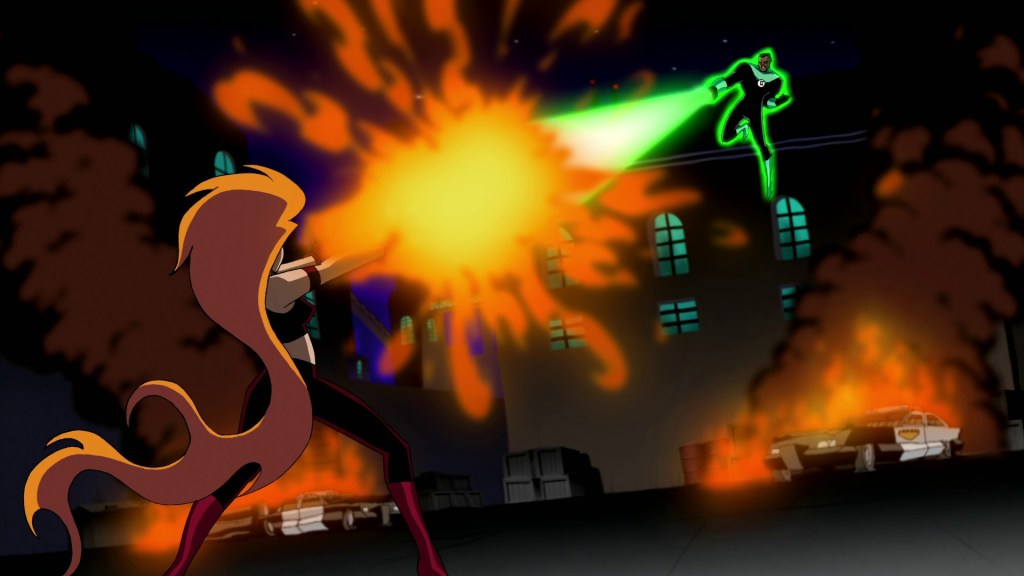
The Justice League arrive to help with the prison break, as a number of supervillains are among the inmates. Batman and Green Lantern help recapture Volcana and Firefly.
Learning of Dee (who is nowhere to be found), the machine, and dozens of sleeping inmates, Bruce opts to investigate further, refuting the idea Dee is not a threat.

Dee goes straight after his wife, entering her dreams and adopting the new persona Dr. Destiny. Worse still, she’s unable to be woken from the forced nightmare, even by doctors.
Batman sneaks into her hospital room with J’onn J’onnz, who uses his own telepathy to enter her mind, while the rest of the League get very… very… sleepy…
To Be Continued…

Best Performance
William Atherton is a perfect casting as John Dee, capturing the sinister undertones behind such a boring man. I’ll talk about it more below, but the entire reason this character works is that he seems so mundane before he gains his powers, and Atherton is responsible for like 70% of that. His subdued evil laugh at the end (accompanied by Michael McCuistion’s ‘lullaby’ infused score) is stunningly subtle given cartoons’ usual level of bombast. To me this is way scarier than an over the top cackle.
Always nice to hear from Peri Gilpin, and I liked Mark Rolston’s work in the past too, so I’m glad they tossed Volcana and Firefly in among the other returning villains. Rolston’s “I think I’m in love” justifies the return, while Gilpin is dynamite with every line, particularly her sarcastic thanks for help she doesn’t need at all.
Episode Ranking
This episode’s A-Story is almost entirely set-up, fitting of a two-parter, but they offset that tremendously by making the B-Story all-action and fan-service. Basically taking the best elements of how they used to do multi-part episodes and executing both at once.
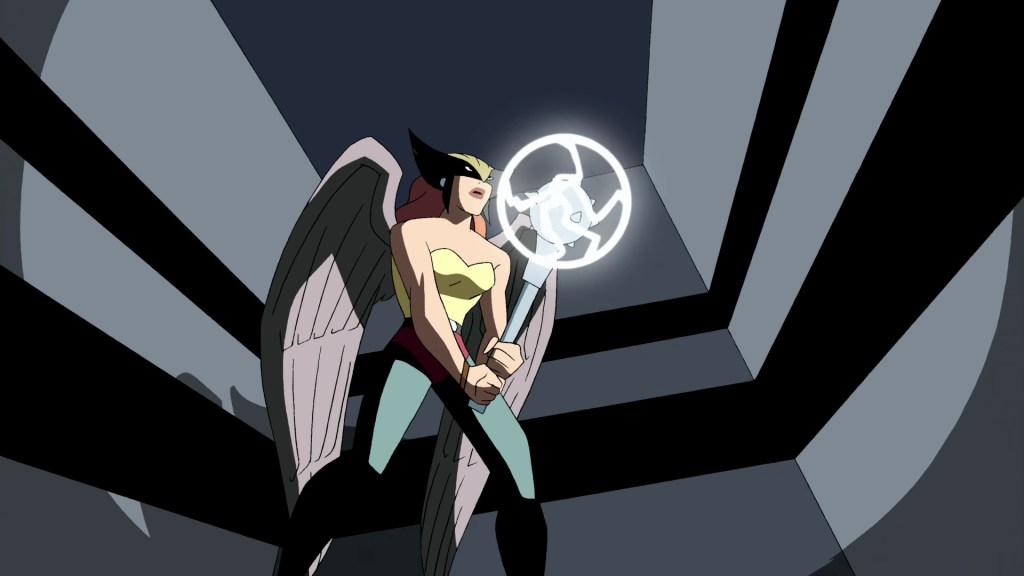
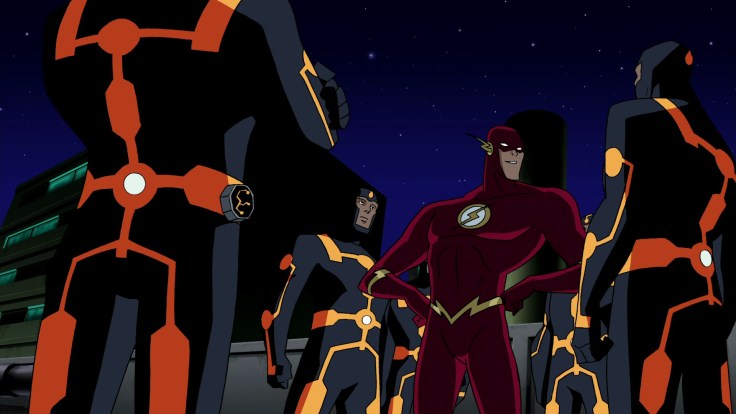
I’m actually going to start with the B-Story, as it takes up a surprising amount of the runtime, but not in a bad way. They really made the most of the prison escape, getting a solid ten minutes of material out of it, particularly fight scenes, to offset the ‘unreal’ elements of the episode. The Injustice Gang make sense to bring back, but tossing in Firefly, Volcana and Luminus – returning villains from BTAS and STAS – help make the world feel truly connected and, more importantly, lived-in. The fire-duo make for a fun little fight scene, and it was clever to have John trap them in a dome so they burned through all the oxygen and passed out. Luminus’ trapping of Hawkgirl within a shrinking metal box is really well executed, as you can feel her anxiety and claustrophobia, which is particularly striking as she’s been so fearless and unflappable throughout the series. Flash should be the perfect foil for Luminus’ cloning trick (especially as he’s an obvious stand-in for Mirror Master) but they sure do love to nerf Flash, and he instead catches a huge beatdown, albeit a nicely animated one that illustrates how far we’ve come on that front in a few short years. I also really liked Superman getting smarter and using his super-vision to spot the real Luminus as the only one giving off heat. I’m certainly not calling the main story boring, far from it in fact, but I just think it makes sense to toss in a lot of fights to keep kids engaged.
John Dee is a great character and I’ll talk a lot more about him below. For now I’ll simply say he’s very well written and drawn, and even better voiced. They are a smidge heavy-handed with saying the themes out loud at one point though; I appreciate a good shoutout to The Odyssey as much as anyone, but Batman likening Dee being more dangerous than he seems to Odysseus tricking the Cyclops by saying his name was ‘nobody’ was a HUGE stretch.
But even with that, having him almost melt into the background after his strong introduction, with returning villains taking centre-stage and Green Lantern verbally dismissing him as a non-threat, is such a smart scripting choice. Hence me covering the B-Story before the A-Story. Stan Berkowitz wants you to engage with that more to sell the idea of Dee as the true threat later.
Speaking of that strong introduction, I enjoyed the opening dream sequence, with the Materioptikon taking on a robotic monster form and Dee growing gigantic to effortlessly beat the Justice League, while they make economical use of villain character models and short voice actor cameos (likely tacked onto the end of another session). Having the whole thing play out while he’s still dressed in his grey prison uniform and not yet having chosen an alter-ego achieved the absurdist, dreamlike quality they were seeking.
There’s some fun social commentary about the prison industrial complex bubbling beneath the surface here, from the ethics of testing a dangerous sci-fi machine on inmates, to the way the riot is handled, to whatever blanks you want to fill in about the parole process. They obviously lack the language to properly engage with it, but intentionally or not, it stimulated parts of my brain these shows seldom manage.
They have a LOT to play with in Part II, as they barely scratched the surface of Dee’s nightmare powers, and The League all passing out telegraphs that we’ll be exploring each of their subconscious minds, which should be fun and fascinating. Strong start, high placement, let’s see if they can make good on it all next time.
- The Savage Time
- Legends
- Twilight
- Only a Dream (NEW ENTRY)
- Injustice for All
- Paradise Lost
- In Blackest Night
- Tabula Rasa
- The Enemy Below
- Secret Origins
- A Knight of Shadows
- Fury
- War World
- Metamorphosis
- The Bold and the Brave
Rogues Roundup

Dr. Destiny (William Atheron) (first appearance)
Similar to Lex Luthor being so good because he can feign being a good person when he needs to, John Dee works so well because on the surface he’s so unassuming to the point of being harmless. In some ways they try to convince you he’s just a nice man, potentially wrongly incarcerated and about to get out and turn his life around. He’s polite, personable and quiet. The guard even says he’s not like the others. But likewise the darkness within is abundantly clear from the jump, as we meet him in a dream where he’s a supervillain, and then he instantly demonstrates an addiction to the machine. Any illusions one might have about his character melt away from the one-two punch of screaming at his wife (even if she did just reveal she’s found a new lover) and manipulating the rapport he built with the doctor only to knock him out, all under the guise of concern for the man’s safety. It’s also a nice touch to have him steal a lab coat to wear over his uniform, a psychologically telling choice on his part.
Doing all that subtle (for a cartoon) work with an ostensibly dull person creates a delightful contrast when he later dons his Skeletor costume and starts trapping people in perpetual nightmares. Though even this radical physical transformation is couched in Dee’s mediocrity, as the whole thing is a cosplay on his part. Even the name – sincere in the comics – takes on new life as the unimaginative/rote choice of Captain Boring.
It’s a very high debut, but he will have to earn my faith in him in Part II.



The Injustice Gang (fifth appearance)
I’m being very liberal with membership here and tossing Volcana, Firefly and Luminus into their numbers. Call it ‘the collection of villains that happen to be in this prison’ if you want, I don’t care. This is The Injustice Gang to me.
Having Lex Luthor and Joker front and centre in the opening dream sequence to praise Dee was smart, and they again got 2 for the price of 1 as Hamill always tosses in some Solomon Grundy for good measure. Having the two headline villains of the DCAU be actually present for the prison break would have stolen too much focus, but they were still technically in the episode, so they get to have it both ways.
Volcana puts in a really strong showing, mowing through the prison guards/cops and doing a decent job against Green Lantern, showing off a new Human Torch style ‘flame on’ mode. Solomon Grundy sure does smash a bunch of stuff but ultimately gets beaten back surprisingly easily, and then Martian Manhunter almost solos him. Every good villain group has a resident idiot, and they do a great job of making Copperhead look dumb as he gets stuck 100 feet in the air with Hawkgirl and no option but to surrender.
All in all, the Injustice Gang are perhaps being done some favours by non-members to rise up the list, but I think the philosophy behind the group is more about how the creative team wield Justice League‘s sense of scope and the ever-growing size of the DCAU. They have this deep, rich stable of baddies to pull from, and even ones you may have forgotten about can cause a surprising amount of trouble for The League. It’s kind of like how the strength of The Jokerz in Batman Beyond isn’t in their literal actions as they’re just a bunch of punks that pose minimal threat, but instead what they represent: Joker’s lasting legacy. The Injustice Gang are more than just a collective of lesser grunts, they’re a nod to how many enemies The League have made over time, and that eventually even these godly seven may not be enough…
- Lex Luthor
- Darkseid
- The Joker
- The Injustice Guild (and Brainwave!)
- Vandal Savage
- Dr. Destiny (NEW ENTRY)
- Amazo
- The Injustice Gang (↑)
- The Imperium
- Brainiac
- Hades
- Draaga
- Aresia
- Deadshot
- Orm
- Simon Stagg (and Java!)
- Felix Faust
- Morgaine le Fey
- The Manhunters
- Kanjar-Ro
- Mongul
- Gorilla Grodd
 The Matt Signal
Leave a comment